Protocol #3: The Shift From God to Images in Faith and Existentialism
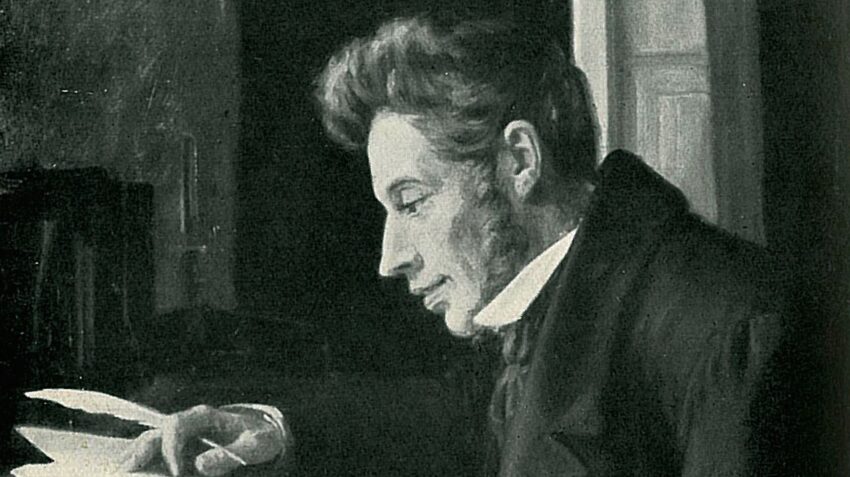
Image via Mental Floss
In the Preface of Fear and Trembling, Søren Kierkegaard (under the pseudonym Johannes de Silentio) asserts that humans have moved beyond faith in God towards doubting God, and then they even choose to move further than that, attempting to find meaning beyond God. He implies, then, that everyone must begin with having faith in God, because without first having faith, they cannot opt to move beyond that faith. However, in Kierkegaard’s time, this progression takes far less time than that in any other era: all rationalists have “made this preliminary movement and presumably so easily that they find it unnecessary to say a word about how” the enlightenment found any “prescription with respect to how a person is to act in carrying out this enormous task” of living without faith in God (94). Meanwhile, the ancient Greeks held that the journey towards acquiring and doubting faith was a “task for a whole lifetime” — even for the most respected Grecian philosophers.
Kierkegaard then describes the knight of faith: a man who wanders around life in semi blissful confusion: he “finds pleasure in everything” even when it appears that “he has lost his soul to Italian bookkeeping.” It “would be impossible to distinguish him from the rest of the crowd.” He “believes that a delectable meal is waiting for him,” even though he has no money (96). Most importantly, he goes to church. To many rationalists and enlightenment thinkers, this man seems irrational and absurd: he does not think critically about his surroundings, nor is he aware of the structures and systems that dictate his well-being. However, for the knight of faith himself, this lifestyle is ideal: he is happy regardless of circumstance. He is free from worry, because “he lets things take care of themselves” and “he does not do even the slightest thing except by virtue of the absurd” (97).
Should we all live like the knight of faith? On one hand, it is easy to argue that losing oneself in faith is the only way to be free from worry. Kierkegaard agrees that humans should seek the lifestyle of the knight of faith, although he finds that it is not necessary to believe in God to do so; it is only necessary to believe in the absurd. These questions are still important today, but instead of having faith in God, humans have faith in the media and other images that bombard their day-to-day life. Today, life imitates advertising in that we get so caught up in images of reality that we lose touch with reality itself. Then, in the 21st century, having faith in images is comparable to having faith in God: we model our lives after these images, asserting our faith in them every time we post a picture on social media, take a postcard-perfect vacation photo, or purchase overpriced leggings for the “fitness aesthetic.” These ideas reflect much of Jean Baudrillard’s work in the 20th century.
To follow Kierkegaard’s logic, it is not necessary to have faith in images, but it is possible to accept the absurdity of this hierarchy of images and simulacra while still taking part in the benefits that these images provide. It is possible to prune your home decorations Pinterest board while still recognizing the absurdity of spending hours trying to make sure that your laundry room mimics the picture-perfect laundry rooms on social media. This type of understanding of the Absurd is reflected in Camus’ work as well: it is the constant oscillation and tension between finding everything meaningless and finding meaning in everything that becomes an understanding and embrasure of the absurd. And, as Kierkegaard argues, embracing absurdity allows us to live just as freely as the knight of faith while at the same time living just as skeptically as his rationalist contemporaries.
Søren, Kierkegaard. “Fear and Trembling, Dialectical Lyric.” The Essential Kierkegaard, edited by Howard V Hong and Edna H Hong, Princeton University Press, Princeton, NJ, 1980, pp. 93–101. https://www.mentalfloss.com/article/535132/facts-about-soren-kierkegaard


Leave a Reply