Protocol #5: An Exploration of Morality, Justice, and Retribution in Nietzsche’s Aphorisms
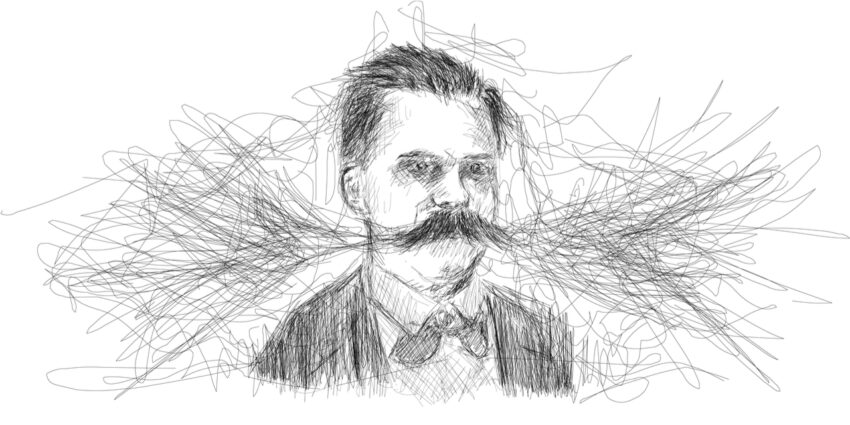
Image via New Ideal
Nietzsche’s aphorisms from “Mixed Opinions and Maxims,” “The Wanderer and His Shadow,” “The Dawn,” and “The Gay Science” can best be described as lists of hot takes: little snippets of wisdom and mind-ramblings from a highly controversial philosopher. And, although Nietzsche provides a variety of entertaining tidbits (my favorite is “Don’t touch! — There are terrible people who instead of solving a problem, bungle it and make it more difficult for all who come after”), Nietzsche’s aphorisms can also provide a framework for morality, justice, and punishment in modern society (185).
First question: what is justice? Googling “justice” got me to the point where I knew that justice was “just behavior or treatment,” which didn’t help much, but the idea of justice as fairness seems especially relevant here. If you were in high school debate (like me!), you might say that “justice is giving each their due.” It’s important to note that in a democratic Western society, justice has the connotation of retributive justice. The idea that “if you do something bad then you’ll be punished” is useful when deciphering Nietzsche’s related ideas of punishment and revenge.
But first let’s answer the question: What does Nietzsche think about justice? In order to make sure that I was properly characterizing his philosophy, I had to cheat a little and read the aphorism “Origin of Justice” on page 168. In this passage, Nietzsche identifies equality as the most important aspect of justice: he says that “justice is repayment and exchange on the assumption of an approximately equal power position,” and that “revenge originally belongs to the domain of justice” (168).
How does revenge relate to justice? Nietzsche describes two types of revenge. The first is instinctual, and it comes from the desire for self-preservation. If something strikes you, then you strike back “in order to get away with life and limb.” The second type of revenge is calculated revenge. It requires a “reflection on the other person’s vulnerability” because “one wants to hurt” the person from whom they are seeking revenge. Nietzsche finds that revenge is only just when it involves honor, because that is the only thing that can be restored. By exacting revenge against someone, we “demonstrate that we do not fear [them]: this constitutes the equalization, the restoration” that manifests as justice (180-181).
Punishment is also a form of revenge, because it seeks self-preservation by desiring to “prevent further damage; it desires to deter.” Nietzsche seems to have mixed feelings of punishment. He at first suggests that punishment can be a way to seek justice as it is a form of revenge, and in “Remorse,” he mentions that “every evildoer who is punished may feel that he is a benefactor of humanity” because punishment prevents others from committing the same harms that you have done (185). However, in “Punishment,” he finds that punishment “does not cleanse the criminal” and “it pollutes worse than the crime does” (190).
We can somewhat reconcile this contradiction by assuming that although Nietzsche doesn’t think that punishment actually solves anything, but it is necessary to prevent future evils because it deters others from committing those same crimes. However, this version of punishment leads us the the question: What is good and evil? In other words: What is morality?
Before diving into Nietzsche, I decided to ask some friends “what is morality?”. I figured that they would be far less confusing than Nietzsche, and it got me thinking about how many perspectives there are. Although most people in the group chat ignored me, here’s what some friends said:
“My grossly simplified answer is that a moral action is one that makes everyone happier overall”
“It may be about ensuring, on some level, a functioning society and grounds for mutual trust”
Okay, so what does Nietzsche think about these answers? He isn’t satisfied. Nietzsche is skeptical about ideas of morality in modern society. He criticizes objective systems of morality by saying that morality is based on the idea that “society is worth more than the individual” — morality doesn’t care “whether the individual suffers from an institution that is good for the whole” because “the philosophy of the sacrificial animal is always sounded too late” (174-175). Although it seems that Nietzsche is specifically attacking utilitarian versions of morality, he does not make that distinction: he generalizes all types of morality to have this consequence. It follows from Nietzsche’s perspective that objective morality, then, is inherently oppressive because it prioritizes the well-being of society over the well-being of the individual, and some individuals will be sacrificed towards these ends more than others.
Nietzsche’s idea that there is no morality (or at least no objective morality) seems to generate a giant paradox when compared to his definitions of justice and punishment. In order for any sort of punishment to be justified, society needs to presuppose some moral framework to determine what type of punishment is proportional. However, if all moral frameworks oppress individuals and create inequalities, then all morality is unjust, and all justice is therefore unjust.
It is unlikely that this paradox is unintentional. Nietzsche points out the absurdity of justice systems by assuming that justice systems are just and proving that they are unjust, generating a contradiction. An emerging theory that comes close to solving this problem is the idea of restorative justice. Restorative justice focuses on repairing harms rather than on retribution, and it values individual relationships and agreements between victims and perpetrators rather than judge-determined sentences.
Restorative justice’s focus on restoring “equity, balance and fairness in human relationships” reflects Nietzsche’s definition of justice as an equal exchange in which “one gives the other what he wants… and in return one receives what one wants” (Callender 43, Nietzsche 168). Additionally, restorative justice rejects the idea that justice and morality is determined by the community, which addresses Nietzsche’s observation that objective moral systems (like the legal system) always oppress some individuals. Finally, restorative justice agrees with Nietzsche that retribution does not imply justice: seekers of vengeance “almost regularly bring about further harm to [themselves]” and that “punishment does not cleanse the criminal” (185, 190). Although restorative justice also disagrees with Nietzsche on several points (for example, Nietzsche believes that punishment is useful insofar as it deters others from committing the same crimes), Nietzsche’s ideas are revolutionary in terms of their implications on modern justice systems.
Callender, John S. “Justice, Reciprocity and the Internalisation of Punishment in Victims of Crime.” Neuroethics, vol. 13, no. 1, 2018, pp. 43–54., https://doi.org/10.1007/s12152-018-9367-6.
Nietzsche, Friederich. On the Genealogy of Morals and Ecce Homo. Edited by Walter Kaufmann, Vintage Books, 1989.


Karya Bintang Abadi
Great website you have here. You have such a beautiful way of writing. Wonderful work! This is the type of information that should be shared around. Excellent article and a really helpful one, thanks for sharing.
Karya Bintang Abadi
Jeanne Riedel
I really enjoyed how this article explores the ideas of morality, justice, and retribution through Nietzsche’s aphorisms. It takes some pretty deep philosophical concepts and makes them easier to grasp, while still keeping the complexity and nuance intact. The thoughtful analysis definitely encouraged me to reflect more on how justice is understood and applied in society.
Jeanne Riedel
This exploration of morality, justice, and retribution through Nietzsche’s aphorisms is truly compelling. I appreciate how the writer connects abstract philosophical ideas to practical human experiences. It’s fascinating to see how Nietzsche’s reflections still challenge our understanding of justice and moral balance today.
Jeanne Riedel
I found this discussion of Nietzsche’s ideas on morality and justice really thought-provoking. The way it connects his philosophy to modern human behavior makes it easier to understand why his work still matters. It’s a great reminder of how timeless his reflections on power and ethics truly are.
Karya Bintang Abadi
You have such a beautiful way of writing your mind. Such a wonderful work! This is the type of information that should be shared around. Excellent article and a really helpful one, thanks for sharing.
Karya Bintang Abadi
Karya Bintang Abadi
You have such a beautiful way of writing your mind. Such a wonderful work! This is the type of information that should be shared around. Excellent article and a really helpful one, thanks for sharing.
Karya Bintang Abadi